Consultancy work (most recent first)
Digital transformation pilots
Jisc consultancy work to support 25 universities in a pilot of the Jisc digital transformation framework, maturity model and other materials.
December 2023 – July 2024
Digital strategy for a UK university
Jisc consultancy work to produce a digital strategy and implementation plan with a UK university
August – November 2023
Review of CPD for a UK university
Jisc consultancy work to review CPD course provision and potentials for a UK University
June – August 2023
Digital transformation
Jisc consultancy work to produce a maturity model for digital transformation in HE and a toolkit to support digital transformation
March – October 2023
Report for Welsh Government
Jisc consultancy work to produce a report to inform strategic thinking and action planning for digital and blended learning in the Welsh further education (FE) sector, as part of the Digital 2030 Call to Action. (in collaboration with Helen Beetham) – A review of research, policy and practice for planning digital and blended learning
April- June 2023
Pebblepad
Digital capability reflective workbook for teaching staff
December 2022 – February 2023
Digital transformation
Jisc consultancy work to produce a framework for digital transformation in HE
October 2022 – March 2023
Jisc digital capability role profiles and frameworks
Jisc consultancy work to update Jisc role profiles, digital capability frameworks and updating discovery tool question sets and feedback
Producing a new digital leader question set and feedback for the discovery tool.
March to August 2022
Digital transformation and digital leadership
Jisc consultancy work with some UK universities to produce digital transformation strategies, development plans and templates. Production of a bespoke online digital leadership course.
October to February 2022
Pebblepad
Digital capability reflective workbook for students
December 2021 – May 2022
University curriculum review
Jisc consultancy to work with a UK university to
- Develop a University curriculum framework
- Identify and adapt useful models of curriculum and learning design
- Production of curriculum design materials and other guides based on university needs
August – September 2021
Jisc Digital Elevation Model
Content producer for DEM tool for the Further Education and Skills sector senior managers
July – September 2021
Jisc Digital Capability Discovery Tool Service
Resource collections in the Discovery tool. Content management, procedures and guidance materials.
October – September 2021
Jisc Digital Capability Discovery Tool Effective online teaching question set
Establish and lead a review group and process to develop a new question set on Effective online teaching for staff working in HE and FE educational institutions, for the Jisc discovery tool. Identify section headings, produce questions and feedback and collate appropriate resources.
July – Sept 2020
Jisc Digital Capability Discovery Tool Service
Resource collections in the Discovery tool. Content management, produce procedures and guidance materials.
October – July 2020
Jisc Digital Capability Discovery Tool Accessibility and inclusion question set
Establish and lead a review group and process to develop a new question set on accessibility and inclusion for staff working in HE and FE educational institutions, for the Jisc discovery tool. Identify section headings, produce questions and feedback and collate appropriate resources.
June – Sept 2019
Jisc Digital Capability Service Digital Wellbeing study
Establish a shared vocabulary around digital wellbeing, identify good practice in the higher and further education sectors, produce recommendations for the Digital capability service.
April – August 2019
Jisc Digital Capability Discovery Tool Service
Support the transition to service of the Discovery tool. Content management, produce procedures and guidance materials.
November 2018 – July 2019
FP Business website

Redsign of FP Business website
October 2018
Jisc Digital Capability Discovery Tool – Pilot phase
New contracts to work with a team to pilot the Jisc Digital Capability Discovery Tool and create a series of assessments for staff and students in UK FE, Skills and HE sector.
https://digitalcapability.jisc.ac.uk/
March – Sept 2018
Jisc Digital Capability Human Resources study
Review of how Human Resources (HR) departments in universities and FE colleges are supporting staff with the development of their digital capability. See this blog post about the final outcomes. Download two slide sets produced to help HR teams engage with the Jisc digital capabilities framework.
Building digital capabilities of staff: involving Human Resources teams in organisational approaches
October 2017 – June 2018
Jisc Digital Capability Discovery Tool – Phase 2
Work with a team to amend content for several versions of the Discovery Tool following feedback and deliver a pilot at end of 2017
August 2017 – Sept 2018
Jisc FE & Skills Teaching Discovery Tool
Creating feedback and resources returned by the tool. Evaluation of the tool. Internal report
June – July 2017
Scottish Autism Women and Girls animated videos
Producing a series of videos for Scottish Autism on women and Girls and autism, covering diagnosis, parenting, mental health, education, employment and wellbeing.
July – August 2017
Jisc Digital Capability Discovery Tool
Work on feedback and resources returned by the tool when results are delivered
Feb – April 2017
Commonwealth Digital Education Leadership Training in Action (C-DELTA)
Creating Modules 1-3 of the Commonwealth Digital Education Leadership Training in Action (C-DELTA) – Mobilising resources, Developing digital identity and Engaging with networks.
Live online course in digital leadership
March – July 2017
Jisc What makes a successful online learner webinar
A Jisc online webinar in January 2017 which presents an overview of key findings from the digital student online learners study which included a literature review of current research and consultation with online learners and staff through the #OLSuccess week. The final report What makes a successful online learner? offers recommendations for institutions, staff and learners to support and improve online learners’ digital experience.
12th January 2017
Jisc Digital Capability Playlists
Collation of resources to support the Digital Capability Discovery tool.
December – July 2017
Open University Language teaching evaluation
Evaluation of pilot online classroom activities for OU language teaching
January – Sept 2016 (Internal report only)
Jisc review of online learners’ expectations and experiences of the digital environment
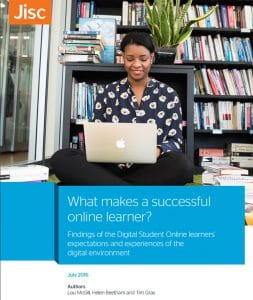
Review of existing research into expectations and experiences of online learners in higher education (HE) and further education (FE) and skills.
March – July 2016
Range of outputs from the study
- a scoping study and commentary (pdf)
- an online library of the research literature that made up the literature review
- a printable bibliography (pdf) with links back to the online library
- #OLsuccess week summary report (pdf) and lots of other resources about the weekFinal report – What makes online learners successful
Jisc Scaling up Online Learning Guides and Diagnostic Tool
Development of the content for the Scaling up online learning Toolkit and working with SkillSet Limited to develop the diagnostic tool as part of the Online Course for the project.
April – March 2016
online learning readiness tool
Guides and checklists
- Scaling up online learning provides a strategic view of different models and the implications of implementing online learning at an institutional level
- Curriculum design and support for online learning helps you make decisions around curriculum design and determine support needs when scaling up online learning
- Technology and tools for online learning provides guidance, resources and case studies around the use of technology to support online courses and distance learning programmes.
Improving social capital for learning
Part of an Open University team researching how professionals self-regulate their learning through (and after) an editathon (Wikipedia editing event at University of Edniburgh). Looking at how professional practice changes. Contributed to instrument design and carried out online interviews with participants.
July – December 2015
FP Business services websites
Development new website for FP Business Services
Digital capabilities frameworks
Contribution to Jisc study led by Helen Beetham
March – July 2015
Revisiting digital capability for 2015
Framework reviewhttps://docs.google.com/document/d/1Uq0lw18XVqow5sUBQniJrpcV1qF1sPqKSC73SdvhPQU/
Evaluation of Coventry University Open Media Courses
Evaluation of Open Media Courses at Coventry University on behalf of Jisc. https://loumcgill.co.uk/coventry-open-media-classes/
January 2014 – July 2015
Research study – Open Self-Regulated Learning OSRL
Working with Glasgow Caledonian University on research into open self regulated learning with participants of the Introduction to Data Science MOOC.
Oct 2014 – December 2014
Open University FutureLearn MOOC Evaluation
Evaluation study of FutureLearn OU Courses
May 2014 – July 2014
Research study – Self-Regulated Learning and professional practice
Working with Glasgow Caledonian University on research into self regulated learning and professional learning with participants of the fundamentals of Clinical Trials MOOC.
December 2013 – February 2014
Open University MOOC Facilitator Review and Evaluation
Evaluation study of FutureLearn OU Course Facilitators.
January 2014 – February 2014
JISC Digitisation and OER
Synthesis of outcomes and outputs from this strand of projects and incorporation into the OER infoKit
January – July 2013
Digitisation & OER: synthesis report
Short url: http://bit.ly/digitisationandOER
Download as a pdf document
OER4Adults
Overview and Analysis of Practices with Open Educational Resources in Europe. European Commission Joint Research Centre.
August 2012 – June 2013
Working with Glasgow Caledonian University the project aims to provide an overview of Open Educational Practices in Europe by identifying, describing and classifying a comprehensive number of OER initiatives in Europe in the area of Lifelong Learning and adult education. It will identify bottlenecks and barriers to the innovative implementation OER in adult education and to discuss factors for the successful implementation, up-scaling and mainstreaming of innovative practices with OER.
Final report (including inventory, typology, and SWOT analysis)
Fluid learning: vision for lifelong learning in 2030, in Open Education 2030 part 1: Lifelong Learning. This was our response to a call for vision papers by IPTS in preparation for the workshop in Seville in April 2013.
OER4Adults SWOT Summary draft for Seville workshop April 2013
OER4Adults Seville presentation v3 Presentation from Seville workshop April 2013
JISC Developing Digital Literacies Programme
July 2011 to July 2013
Synthesis consultant with Helen Beetham to support this programme of activities.
HEFCE OER review
May 2012 – May 2013
A cumulative evaluation and synthesis of the entire HEFCE funded intervention in OER – which includes all phases of UKOER and the Open University SCORE activities.
- Retrospective re-evaluation of the findings from phases 1 and 2, to include the gathering of further data from projects beyond their funded life.
- Evaluation of currently active SCORE supported work, using a methodology compatible with the core UKOER methodology.
- Retrospective evaluation of SCORE supported work, and the incorporation of this into the core UKOER methodology.
- A cumulative synthesis of findings from the above strands and the parallel evaluation/synthesis of UKOER phase 3, and the presentation of this in formats suitable for researchers, policy-makers and a general audience.
McGill, L., Falconer, I., Dempster, J.A., Littlejohn, A. and Beetham, H. Journeys to Open Educational Practice: HEFCE OER Review Final Report. JISC, 2013 https://oersynth.pbworks.com/w/page/60338879/HEFCE-OER-Review-Final-Report
Open University Library user requirements study
User requirements study around staff use of OER – unpublished report.
February – May 2013
Open University Badging Pilot
Following up earlier report and advising on first phase of implementation of badging for informal learners on OpenLearn courses
April – May 2012
OER infoKit updating
December – January 2013
Updating OER infoKit to include outcomes and outputs of UKOER Programme phases 2 and 3
JISC UKOER Programme phase 3 Synthesis and Evaluation Project
October 2011 – March 2013
Member of a team providing a range of activities to support an ongoing evaluation and synthesis of the Open Educational Resources (OER) programmes. The synthesis wiki now holds three years worth of materials and information emerging from three phases of the programme. I led on the development of an Evaluation toolkit and briefing papers for the wider community.
Myscience online strategy review
August – January 2013
Supporting Myscience to conduct a review into their online education strategy for supporting STEM (Science, Technology, Engineering and Mathematics) education professionals.
JISC Relationship Management Programme synthesis
July -December 2012
Synthesis of Strand on Alumni Engagement with JISC CETIS. Relationship Management InfoKit
JISC Innovating Learning Online conference 2012
April 2012 – December 2012
Member of the planning and co-ordination team. Themes and speakers currently being developed for conference in November.
ReACTOR Project, Doncaster College
October 2011 – October 2012
External evaluator for this UKOER project focusing on Renewable, Environmental and Construction Technology Open Resources
Scotlands Colleges – Engagement strategy for Re:Source repository
July – October 2012
Working with Scotlands Colleges to prepare an Engagement strategy and action plan for the Re:Source repository
Open University – badging feasibility study
June to July 2012
Internal Report of work to investigate strategic, operational and technical implications of the potentials of badging for informal learners at the OU. Involved working with a wide range of stakeholders within the institution to ensure that all aspects of institutional needs and students were included.
GCU SRL-MOOC survey
March to April 2012
Carried out interviews for a research survey into Self Regulated Learning which aims to surface, describe and systematise the activities and strategies that adult learners use to self-regulate their learning in the context of a massive open online course (MOOC), in particular Change 2011 MOOC.
Jorum business case
March 2012
Commissioned to write a supporting paper for Jorum business case and input to developing the business case.
A National OER Service for the UK http://repository.jisc.ac.uk/4917/
JISC CETIS Articles and timelines
January 2012 to April 2012
I was commissioned by JISC CETIS to write a series of articles and timelines to provide a CETIS viewpoint on the history of developments in three key areas of activity since the early 2000’s.
- Learning Environments Timeline: The JISC CETIS view (co-written with Sarah Currier) and the learning environments timeline
- eXchanging course related information – XCRI timeline and the XCRI timeline
- Open Educational Resources timeline and the OER timeline
JISC HE Academy UKOER programme phase 2 – synthesis and evaluation
Synthesis and evaluation of the programme which built on the pilot porgramme activities (see below). Final synthesis report of UKOER phase 2 Authors: Lou McGill, Helen Beetham, Isobel Falconer, Allison Littlejohn. November 2011
JISC CETIS other voices
I wrote a series of articles for JISC CETIS Other voices blog about the JISC Institutional Approaches to Curriculum Design Programme
Curriculum Design: The Big Picture June 2011
Curriculum Design: X marks the spot? July 20
XCRI-CAP – now is the time August 2011
Literacy in the Digital University (ESRC funded series of seminars)
Participated in a seminar series with a group of researchers and practitioners from different disciplinary backgrounds who were interested in the use of digital modes of communication in post-school education, to problematise the concept of Literacy in this context, to evaluate teaching and learning practices informed by the concept of digital literacy, and to form a research network that will stimulate further research and critical evaluation in this highly significant area of educational development.
The series addresses an educational context in which institutional policies and strategies are beginning to reflect new pedagogical and business models centred on social networking technologies and the blending of formal and informal learning (Katz 2008, Seely Brown & Adler 2008, Trinder at al 2008, Walton et al 2008). We use the term university to indicate the central focus of the research agenda which will be a key output of the series – the seminars themselves will focus on a variety of formal and informal contexts of learning in the post-school sector (FE; HE; Libraries, and other areas of public, corporate and professional education), in recognition of the converging of aspects of curriculum and practice across these domains that is shaping the development of the university in the digital age.
publication:
Littlejohn, A., Beetham, H. and McGill, L. Digital literacies as situated knowledge practices: academics’
influence on learners’ behaviours in Goodfellow, R and Lea, M. (eds) Literacy in the Digital University? Critical perspectives on learning, scholarship, and technology, Routledge, 2013 (forthcoming July 2013)
JISC Online Innovating e-Learning Conference November 2011
June 2011 – November 2011
Member of planning and co-ordination team. The title of the 2011 conference, Learning in transition, reflected the challenges institutions and practitioners face in the fast-changing landscape of post-16 education, including preparing students for employment.
Transforming curriculum delivery through technology
Sept 2008 – April 2011
Member of the JISC synthesis and support team for the Curriculum Delivery projects – in this context curriculum delivery is meant as shorthand to embrace the many ways in which learners are enabled to achieve the outcomes offered to them by a curriculum. Projects focus on processes which take place when real learners engage with a designed curriculum. Teaching, learning support, advice and guidance, coaching, mentorship, peer and collaborative learning, feedback and assessment, personal development planning and tutoring, skills development and practice, and enabling access to curriculum resources are all processes that might be involved. By the term ‘delivery’ we don’t intend that projects should focus on the delivery of information to learners, or suggest that this is an appropriate or adequate way of enabling learners to achieve curriculum goals. Project outcomes and outputs are incorporated into the JISC Design Studio, which I have also been working on in relation to this programme of work. The final synthesis report is entitled Curriculum Innovation: pragmatic approaches to transforming learning and teaching through technologies and was published on 13th April 2011.
JISC Online Innovating e-Learning Conference November 2010
June 2010 – November 2010
Member of planning and co-ordination team. Entitled “Bringing innovation to life: From adversity comes opportunity ” the programme aims to explore how technology-enhanced learning can help universities and colleges to continue to compete globally; support them to meet and overcome the challenges presented by the current climate of economic constraint and to develop forward-looking educational futures.
Digital Repositories Infokit
Launched September 2010
I augmented an existing JISC Infonet infokit to include issues affecting learning and teaching repositories.
OER Infokit
Launched June 2010
I worked on both the structure and content of the JISC Infonet infokit on Open Educational Resources. This work was done in parallel to the OER Pilot Programme work and will be regularly updated as the JISC/HE Academy programme activities continue.
JISC HE Academy UKOER Pilot Programme Synthesis and Evaluation Project
June 2009-August 2010
Project which provided a range of activities to support evaluation and synthesis of the Open Educational Resources (OER) pilot programme. The project developed a wiki to support the programme and also used this to publish the final report. Final report of the JISC/HE Academy OER Pilot Programme Evaluation and Synthesis Team. Authors: Lou McGill, Helen Beetham, Isobel Falconer, Allison Littlejohn August 2010
JISC Online Innovating e-Learning Conference November 2009
July 2009 – November 2009
Member of planning and co-ordination team. Entitled “Thriving, not just Surviving” the programme reflected the challenges facing further and higher education institutions in the 21st century and featured leading thinkers, broadcasters and academics, such as Charles Leadbeater, Nigel Paine, Helen Beetham, Rhona Sharpe (Oxford Brookes University), Peter Bradwell, (Demos). Papers are available on the website, including recordings of many live sessions in Elluminate.
Engaging Learning in Social Software
OCLD course (Oxford Brookes University) June-July 2009 led by Patsy Clarke
Co-tutor – Social software such as Facebook, Myspace, Flickr and Blogger as well as the collaboratively constructed and published information found on Wikipedia are widely used by learners. This course focuses on enhancing teaching and learning by harnessing the potential of social software tools for interactivity and engagement and their incorporation in authentic learning activities. With active participation and collaboration with use of the software tools you will leave the course with ideas for their integration into online and blended coursework.
Study on Learning Literacies for a Digital Age (LLiDA)
July 2008 – May 2009
A JISC funded research study which aimed to find out what literacies learners require and what UK HE and FE institutions are doing to support them. The study aimed to inform JISC and the wider UK FE and HE communities by providing a better understanding of learning literacies, how they are evolving, how requirements are changing, and how they may be supported in different contexts. Thriving in the 21st century: Learning Literacies for the Digital Age (LLiDA project). Helen Beetham, Lou McGill, Prof. Allison Littlejohn. June 2009 (pdf) Thriving in the 21st century: Learning Literacies for the Digital Age (LLiDA project). Executive Summary, Conclusions and Recommendations. Helen Beetham, Lou McGill, Prof. Allison Littlejohn. June 2009 (pdf)
Study on the evidence base in support of sharing learning materials
July 2008 -December 2008
A five month JISC funded study to investigate, identify and articulate the evidence for a range of business cases and models for sharing learning materials within the UK Higher Education community. Informed the HE Academy JICS UKOER programme. McGill, L and Currier, S and Duncan, C and Douglas, P (2008) Good intentions: improving the evidence base in support of sharing learning materials. Project Report.
JISC Online Innovating e-Learning Conference 4-7 November 2008
July 2008 – November 2008
Member of planning and co-ordination teamThemes focused on the productive and energising tension between the tried and tested and the wholly innovative. e-Learning may now have established a foothold in learning and teaching, but are the demands of delivering the curriculum restricting its innovative potential? How can we plan to ensure the best possible e-enhancement of learning in the future? A very successful conference – papers available on the website, including recordings of live sessions.
JISC Online Innovating e-Learning Conference November 2010
June 2010 – November 2010
Member of planning and co-ordination team. Entitled “Bringing innovation to life: From adversity comes opportunity ” the programme aims to explore how technology-enhanced learning can help universities and colleges to continue to compete globally; support them to meet and overcome the challenges presented by the current climate of economic constraint and to develop forward-looking educational futures.

Leave A Comment